Integrating 463L Pallet Conveyor Technology into Military Air Terminals
How automated pallet transport can improve staging, sequencing, and aircraft-loading handoffs.
AI Summary [expand]
Design 463L pallet conveyor systems around terminal staging operations rather than standard warehouse models. Because loaded conditions vary, successful designs integrate conveyors, controls, and recovery access simultaneously. The ideal system minimizes unnecessary handling, organizes pallets effectively, and establishes a predictable, efficient, safe operational workflow from buildup to aircraft loading operations.
Key Points:
- Staging prioritizes control over simple movement.
- Handoffs require more attention than straight runs.
- Automation must support operators when plans change.
The 463L pallet gives military air terminals a standardized platform for moving cargo. What happens around that pallet is rarely as standardized.
Before a pallet reaches the aircraft, it may pass through buildup, inspection, weighing, staging, sequencing, and several equipment handoffs. When those steps are not coordinated well, the same pallet can be moved several times before it gets anywhere near the loading operation.
That is where 463L pallet conveyor can make a real difference.
The objective is not simply to move a 463L pallet faster. Speed matters, but staging usually has a different problem. Cargo has to be held, released, repositioned, and presented in the correct sequence while the terminal continues responding to changing priorities.
A good pallet conveyor system removes unnecessary handling from that process while leaving operators enough control to deal with the exceptions that come with military air cargo.
A Standard Pallet Does Not Mean a Standard Load
The 463L pallet gives the conveyor designer something valuable: a known physical interface.
The load above it is another matter.
Cargo weight, load distribution, overall height, shape, and handling requirements can vary considerably. That means the equipment has to be selected for the range of loads the terminal is expected to handle, not just a typical pallet.
Roller capacity, framing, guides, stops, transfer mechanisms, and powered sections all have to work with the loaded pallet.
This sounds obvious until a conveyor system is designed primarily around pallet dimensions. The footprint may be standardized, but that does not mean every loaded pallet behaves the same way.
A system that handles the easy loads well but struggles with the upper end of the operating requirement is not going to be very useful when the mission changes.
The conveyor has to be designed around the work the terminal actually performs.
Staging Is Where Conveyor Starts to Prove Its Value
A staging lane is more than a place to park cargo until an aircraft is ready.
One pallet may be ready to move while another is still being held. A load may need additional inspection. Aircraft timing may change. The loading sequence may change with it.
That is normal terminal activity.
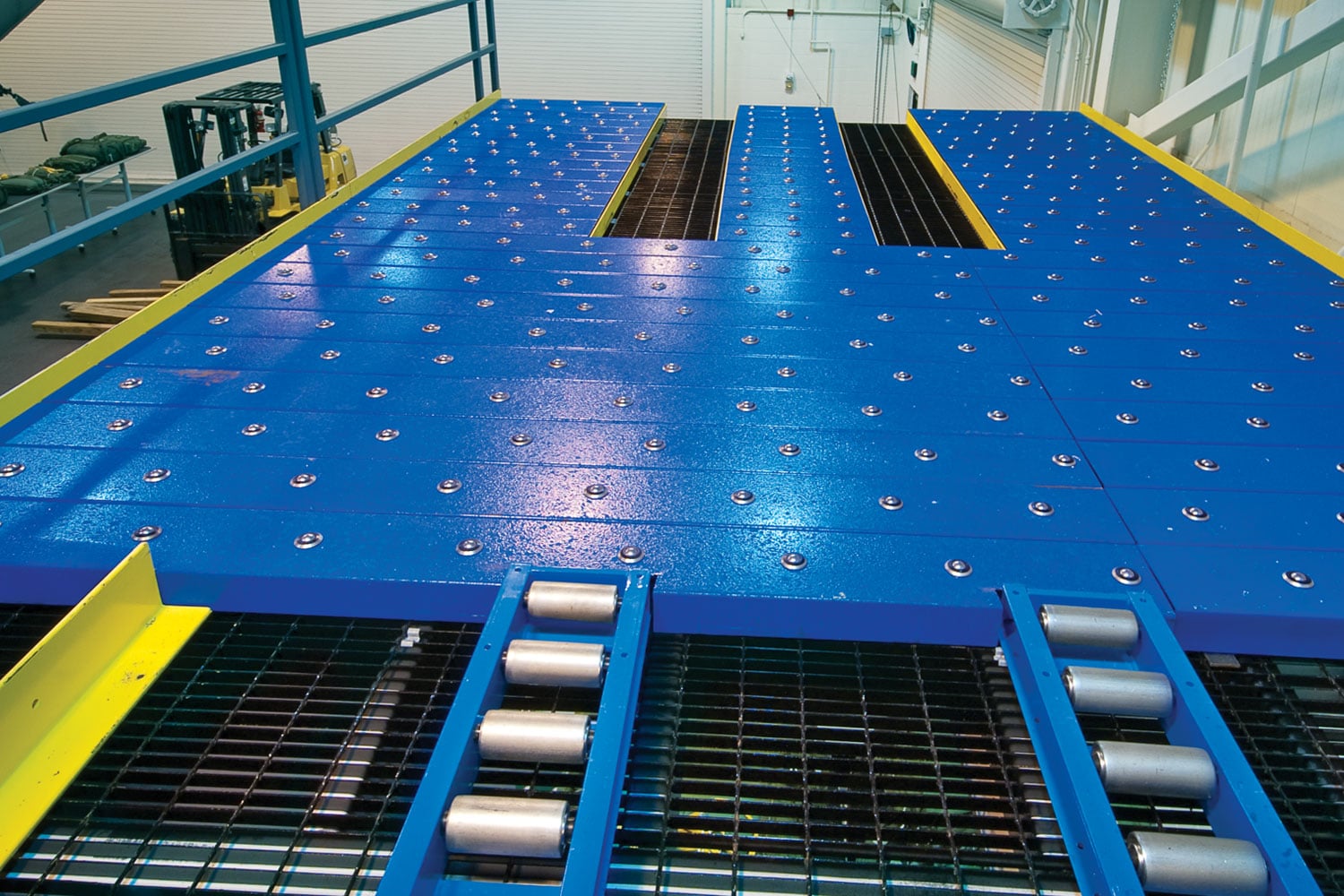
Powered conveyor can give operators a more controlled way to manage those movements. Pallets can advance through defined positions as space opens, remain held when necessary, and move toward the loading point without requiring a forklift every time the line moves forward.
The benefit becomes obvious when you look at how often the pallet is being touched.
If a pallet enters staging, gets pulled out to clear another load, gets moved again because the sequence changed, and then needs another piece of equipment to position it for loading, the terminal is doing a lot of work without moving the cargo very far.
Good staging design cuts down on those moves.
It does not need to eliminate every manual intervention. It needs to make manual intervention the exception instead of the normal way the system stays organized.
Straight Conveyor Is Usually the Simple Part
Most of the harder decisions show up where pallets have to change direction, move between lanes, or leave staging out of sequence.
That is where transfers and indexing become important.
A terminal may need to move a pallet across lanes, merge several staging positions toward a common loading point, or pull one pallet from the normal sequence without disturbing everything around it. There are several ways to accomplish those movements, but adding more transfer equipment is not automatically an improvement.
Every transfer adds mechanical components, sensors, controls, maintenance points, and another place where the process can stop.
The better approach is to start with the staging requirement.
Where does the pallet actually need to go? How often will it make that move? Does the operation need that flexibility every day, or are we adding equipment to solve an exception that rarely occurs?
Those questions usually lead to a cleaner design.
Orientation belongs in the same discussion. If the pallet reaches the end of staging and has to be turned or repositioned before the next piece of handling equipment can accept it, that extra movement should be understood before the layout is finalized.
Get the Aircraft-Loader Handoff Right Early
One of the most important points in the process is where the pallet leaves terminal staging and transfers toward the aircraft-loading operation.
That interface can look deceptively simple on a layout as the conveyor ends, the loader approaches, and the pallet transfers. On the floor, however, elevation, alignment, approach clearance, vehicle positioning, transfer gaps, traffic, and operator access all have to work together.
If they do not, the terminal can gain efficiency through the entire staging process only to give it back every time a pallet reaches the final handoff.
This is not a detail to leave until installation.
The equipment receiving the pallet should influence the staging layout from the beginning.
Forklift access should be planned the same way, accounting for pallets that need additional inspection, unusual loads, maintenance situations, or other exceptions. The objective is not to eliminate forklifts, as they remain useful tools, but rather to keep them from becoming the routine fix for a staging system that cannot handle normal operational changes.
Count the Touches Before You Chase Conveyor Speed
Conveyor speed is easy to specify. It’s also easy to give it too much importance.
In a staging operation, a better question is how many times the pallet has to be handled before it reaches aircraft loading.
If the answer is four or five separate moves, increasing conveyor speed may not improve very much. The pallet will simply reach the next wait point sooner.
A better staging system reduces unnecessary handling. That may come from additional buffer positions, a better transfer arrangement, clearer release logic, or simply a layout that follows the actual loading sequence more closely.
There is little value in moving cargo faster if it only creates another queue. The conveyor needs to match the pace of the complete process.
Automation Still Has to Work When the Plan Changes
Military air cargo is not a fixed production line.
A pallet may be held, priorities may shift, aircraft timing can change, equipment can go down, or cargo may need to leave the normal path. The controls have to accommodate that reality without making the system difficult to operate.
Operators need to know which zones are occupied, which pallets are ready to move, and where a hold has been placed. They also need straightforward local controls, emergency stops, and a practical method for recovering from an equipment problem.
Recovery deserves more attention than it often gets during early design.
If a powered section goes down, can the affected pallet be removed? Can the zone be isolated? Is there another practical way to continue moving critical cargo?
A system doesn’t need to be designed for every imaginable failure.
It does need a reasonable way to keep one equipment problem from becoming a terminal-wide problem. That’s part of designing for readiness.
The Building Still Sets the Limits
Most 463L conveyor installations have to fit into an existing facility.
Columns, doors, floor conditions, electrical service, fire protection, traffic routes, maintenance access, egress, and existing material-handling equipment can all influence the final layout.
A few inches in the wrong place can matter.
A column can change a transfer arrangement. Limited maintenance clearance can make a routine repair more difficult than it should be. Poor vehicle access can create the same problem at the aircraft-loader interface every day.
These conditions should be verified while the system is still being designed. Once equipment has been fabricated, the options become more expensive and more disruptive.
AW Systems applies the same principle across federal material-handling projects: understand the facility before locking down the equipment. That keeps known building conditions from becoming avoidable field problems.
Design Around the Loading Process
A military air terminal does not gain much by moving pallets faster than aircraft-loading equipment can accept them. That only moves the waiting line.
Useful conveyor capacity has to be considered alongside buildup, inspection, available staging positions, transfer time, loader availability, and the aircraft-loading process. One part of the operation cannot be designed in isolation and expected to set the pace for everything around it.
For one terminal, the right answer may be additional staging positions. Somewhere else, reducing forklift rehandling may provide more value. Another facility may need a better transfer point more than it needs additional conveyor length.
There is no reason to automate movement simply because it can be automated. The equipment should solve a problem the operation actually has.
Integrating 463L Conveyor Into Military Air Terminal Operations
A well-designed 463L pallet conveyor system should make staging easier to control, not harder to understand.
Pallets should move into defined positions, remain in sequence when necessary, and reach the aircraft-loading process without repeated repositioning. Operators should have practical ways to manage holds and exceptions. Maintenance and recovery should already be considered before the first pallet is placed on the system.
AW Systems approaches 463L pallet handling as a complete material-handling requirement.
That means evaluating the pallet, staging lanes, transfers, controls, ground-handling interfaces, facility conditions, installation requirements, and long-term service together rather than treating them as separate equipment purchases.
For military air terminals, the objective is practical. Reduce avoidable handling, maintain control through staging, and provide a dependable path from cargo buildup to aircraft loading.
Next Step: Let’s Optimize Your Terminal’s Flow
Whether you are planning a new 463L conveyor installation or evaluating an existing staging layout, AW Systems can help you design a system that works with your facility – not against it.
- Evaluate your current operations: Identify excess handling, staging bottlenecks, and points of friction at the aircraft-loader interface.
- Plan for real-world exceptions: Build in the right local controls, recovery access, and operational flexibility before equipment is fabricated.
- Align equipment with reality: Ensure your automation matches the actual pace, cargo variety, and physical constraints of your terminal.
Contact a GSA procurement expert today to discuss how a purpose-built 463L material-handling solution can improve control, reduce touch counts, and enhance readiness across your air terminal.
AW Systems: One Project. One Vendor.
GSA procurement experts since 1990. Optimized government facility efficiency.
American Warehouse Systems has served as the premier GSA Prime Contractor for complex federal material handling and storage aid systems worldwide. Our expertise goes beyond providing equipment; we understand the intricacies of Federal Acquisition Regulations (FAR), Buy American requirements, and the specific security needs of mission-critical facilities.
American Warehouse Systems (doing business as Industrial Procurement Services, LLC) operates as a dedicated turnkey prime contractor under GSA Contract #47QSWA23D0069.
As an SBA-certified Small Disadvantaged Business (SDB), AW Systems allows federal procurement offices to directly meet strict small business socioeconomic utilization goals while securing industrial-grade execution capabilities.
With deep experience supporting federal logistics infrastructure, AW Systems has deployed thousands of complex storage and structural systems for major military defense organizations and federal government entities.View our Government Client List