
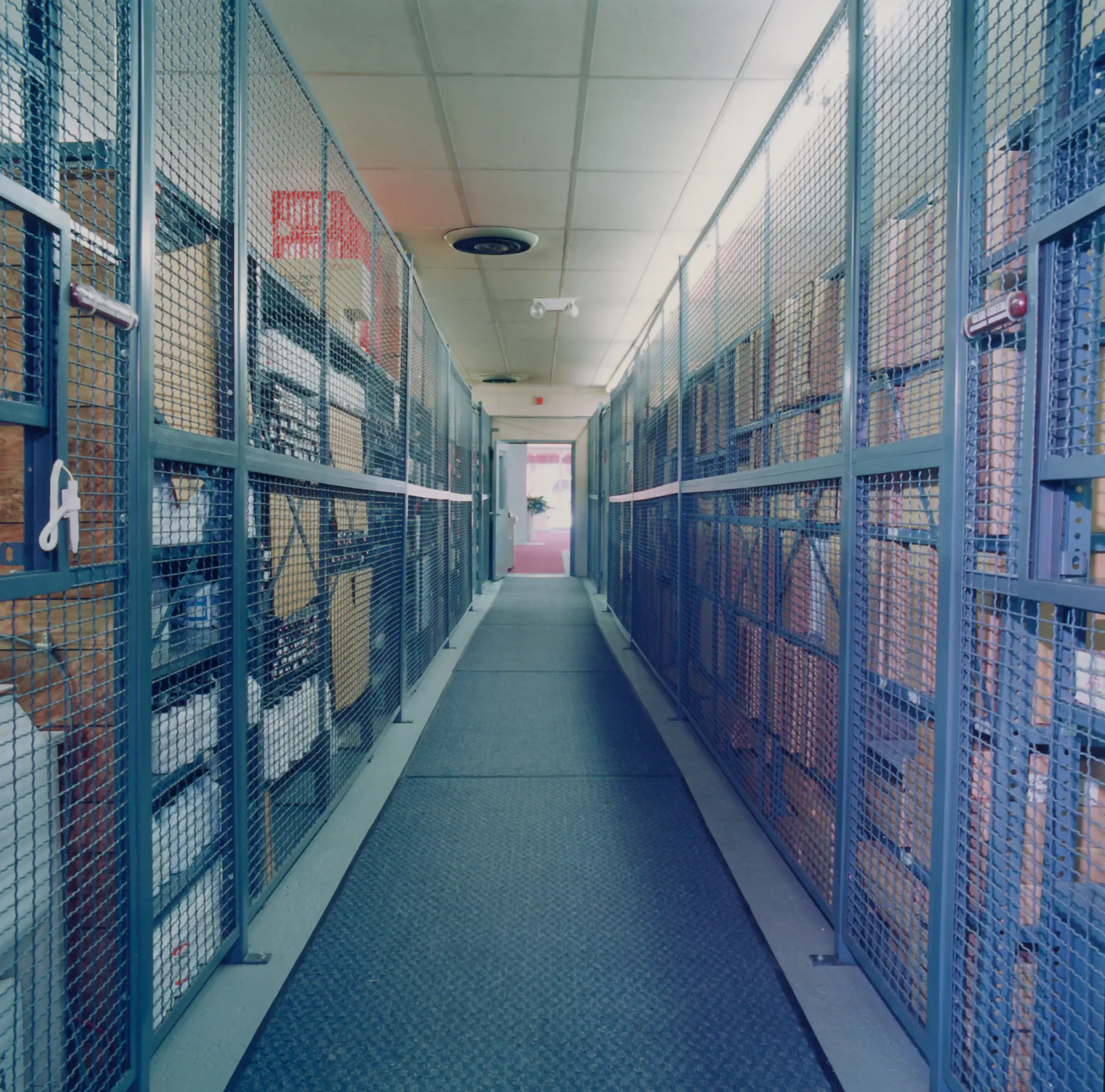
Secured Access Partitions for Asset Isolation in Embassies and Law Enforcement Facilities
Securing High-Value Federal Assets with Modular Access Partitions
AI Summary [expand]
Secured access partitions are most effective when integrated into a broader asset control strategy. Design begins by evaluating protected property and access requirements before specifying hardware, layout, and electronic controls. Tailoring protection to specialized environments, such as evidence, embassy, or military storage, balances security and accountability with daily operational efficiency.
Key Points:
- Define asset and access requirements before selecting partitions.
- Evaluate the full perimeter, including gates, locks, and anchorage.
- Recognize enclosures as part of broader security requirements.
Federal facilities routinely manage evidence, weapons, controlled equipment, accountable property, and other high-value assets that require restricted access.
Secured access partitions and modular wire enclosures can provide that separation without requiring construction of a permanent room. When properly specified, they can establish controlled storage areas, preserve visibility, support accountability, and adapt to existing conditions.
The enclosure should be selected only after the security requirement is understood. A wire partition is not automatically a vault, classified-storage area, or substitute for another approved security method. Its role depends on the asset being protected, the personnel authorized to access it, the facility environment, and any applicable agency-specific requirements.
Define the Security Requirement Before Selecting Equipment
Secure-storage planning should begin with the asset.
Different asset categories may require restricted access, but they should not automatically receive the same enclosure.
The project team should understand who requires access, how frequently material moves through the area, what equipment is used to handle it, whether internal segregation is necessary, and what level of physical control applies to the property.
Those answers drive the design. A personnel-only enclosure differs from one receiving carts or pallets. Evidence storage may require separate areas for intake, temporary holding, and long-term storage. Open mesh may also preserve useful visibility without requiring entry.
The security requirement establishes the design criteria. Equipment selection follows.
Design the Entire Secured Perimeter
A partition system should be evaluated as a complete boundary rather than a collection of panels.
Panel construction and height matter, but so do interfaces with floors, walls, ceilings, columns, utilities, and surrounding construction. An uncontrolled opening can weaken an otherwise sound enclosure.
Overhead conditions require particular attention. An open-top enclosure may be appropriate for some controlled-storage applications. Other requirements may justify a wire ceiling or floor-to-ceiling configuration.
Anchorage must also be addressed during design. Floor construction, joints, embedded systems, and existing conditions can affect how the enclosure is secured. These conditions should be resolved before materials arrive on site.
Treat Access Points as Part of the Security System
The entrance is one of the most heavily used components of any secured enclosure and deserves equal design attention.
Gate width and configuration must support the people and material expected to pass through the opening. A personnel entrance may be sufficient for one application, while another may require access for carts, pallet jacks, evidence containers, maintenance equipment, or larger loads.
Poor gate placement can interfere with aisles, storage equipment, work areas, or material flow.
Locking hardware should be selected with the same discipline. Some applications may be appropriately controlled with conventional key or padlock systems. Others may require institutional hardware, electronic credentials, monitored access, or integration with the facility’s existing security infrastructure.
A high-quality lock does not compensate for a poorly planned entrance. Access control and workflow must be considered together.
Evidence Storage Requires Physical and Procedural Control
Law enforcement evidence facilities illustrate the difference between controlling access and controlling custody.
A secured partition can establish a restricted physical area, but chain of custody depends on the procedures used to receive, document, transfer, store, and release evidence. The physical layout should support those procedures.
Incoming evidence may need to remain separate from processed property, and some categories may require additional internal security or environmental controls.
Shelving, lockers, cabinets, evidence containers, and designated storage zones should be incorporated into the layout so personnel can maintain accountability without unnecessary handling.
The enclosure controls access to the space. The operating process controls the evidence within it.
Embassy and Military Applications Require Clear Security Categories
Diplomatic and military facilities may contain property with different protection requirements.
A modular partition may be appropriate for accountable equipment, sensitive property, warehouse inventory, tools, or other assets requiring controlled access. That does not mean the same enclosure automatically satisfies requirements associated with classified information or other specially protected material.
The responsible security authority determines the required protection. The partition can then serve as the primary boundary, an added controlled-access layer, or part of a broader storage arrangement.
Military logistics environments may likewise require separate access levels for weapons-related equipment, communications hardware, repair components, tools, and other mission-support assets.
Clear security categories prevent the procurement from asking one enclosure to perform functions it was not designed or approved to provide.
Coordinate Electronic Security and Facility Interfaces Early
Modern secured storage often combines physical barriers with electronic access control and surveillance. Those systems should be coordinated during design.
Badge readers, electronic locks, door contacts, alarms, and cameras may require power, data, conduit, mounting provisions, or existing-system connections. Camera coverage also depends on the final layout because internal storage can obstruct sightlines.
The building introduces its own constraints. Columns, floor joints, overhead utilities, sprinklers, doors, aisles, and existing storage can affect the final configuration.
These conditions should be verified before fabrication. Columns may interrupt panel runs, overhead obstructions can limit height, material handling routes can dictate gate locations, and floor conditions may affect anchorage.
The partition itself may be straightforward equipment. Coordinating it successfully within an active federal facility requires a broader understanding of installation, security systems, material flow, and operational constraints.
Plan Internal Storage and Future Reconfiguration Together
The storage equipment inside the secured area should be planned with the perimeter.
Shelving, lockers, cabinets, racks, and evidence storage equipment affect aisle width, visibility, access, capacity, and how efficiently authorized personnel can work. A poorly coordinated interior layout can reduce the usefulness of an otherwise well-designed enclosure.
Future requirements also matter. Modular partitioning can allow the secured footprint to change with inventory, staffing, or operations.
That flexibility is most useful when the initial layout leaves practical options for future panels, gates, storage equipment, and electronic security changes.
Modularity provides options. Good planning preserves them.
Write the Procurement Around the Operating Requirement
A specification that simply requests a “wire security enclosure” leaves too many important decisions unresolved.
The procurement should define the intended use and supporting physical requirements, including footprint, height, overhead condition, gates, locks, internal storage, finish, anchorage, visibility, electronic security interfaces, and anticipated expansion.
Scope responsibility should also be clear.
If access-control equipment is required, the procurement should establish who provides and connects it. If the partition interfaces with existing walls or structures, those conditions should be identified. If surveillance coverage is necessary, the enclosure and internal storage layout should be coordinated accordingly.
Clear requirements reduce assumptions during bidding, engineering, fabrication, and installation.
Building the Appropriate Security Boundary
Secured access partitions can isolate controlled property while maintaining visibility, operational access, and flexibility within existing federal facilities.
Their effectiveness depends on matching the system to the requirement. Evidence storage requires disciplined custody and internal organization. Embassy facilities require clear separation between controlled property and material subject to more restrictive protection requirements. Military facilities may need several levels of asset segregation and access control within one operational environment.
AW-Systems helps federal procurement, logistics, law enforcement, and facility personnel evaluate those requirements before equipment is finalized. Our role includes coordinating enclosure configuration, access, internal storage, facility interfaces, installation requirements, and related material handling considerations.
The objective is a secure, functional boundary that protects the asset without disrupting authorized work.
Next Step
Protecting evidence, military inventory, and diplomatic assets requires matching partition design to specific security and operational workflows. Coordinating layout, access points, and electronic security interfaces early ensures complete asset accountability without disrupting daily work.
Contact AW-Systems today to evaluate your facility requirements or request a tailored GSA procurement quote.
AW Systems: One Project. One Vendor.
GSA procurement experts since 1990. Optimized government facility efficiency.
The Industry Standard for Federal Integration
Since 1990, American Warehouse Systems has served as the premier GSA Prime Contractor for complex federal material handling and storage aid systems worldwide. Our expertise goes beyond providing equipment; we understand the intricacies of Federal Acquisition Regulations (FAR), Buy American requirements, and the specific security needs of mission-critical facilities.
American Warehouse Systems (doing business as Industrial Procurement Services, LLC) operates as a dedicated turnkey prime contractor under GSA Contract #47QSWA23D0069.
As an SBA-certified Small Disadvantaged Business (SDB), AW Systems allows federal procurement offices to directly meet strict small business socioeconomic utilization goals while securing industrial-grade execution capabilities.
With deep experience supporting federal logistics infrastructure, AW Systems has deployed thousands of complex storage and structural systems for major military defense organizations and federal government entities.