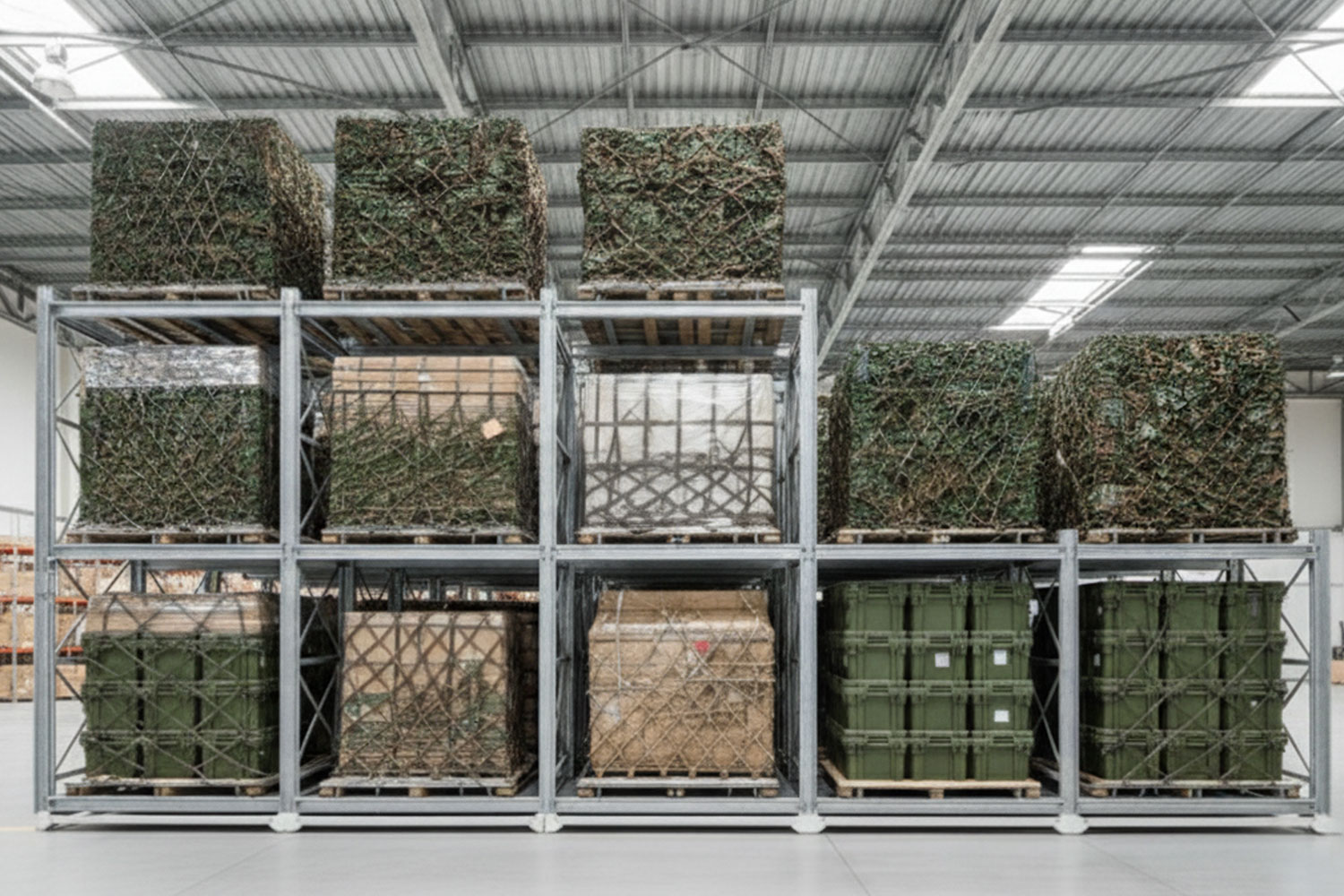
463L Pallet Storage Systems: Strengthening Military Air Cargo Infrastructure

Optimizing the storage and staging of the 463L Master Pallet is critical

The 463L pallet has served as the backbone of United States military air cargo operations since the mid-1960s. Originally developed by the U.S. Air Force to standardize cargo loading across aircraft platforms, the 463L system created a common pallet and restraint method that allowed rapid deployment and efficient aircraft utilization.

Today, 463L pallets remain central to global air mobility operations. From C-130 and C-17 aircraft to forward staging bases and continental depots, the pallet continues to define how equipment and supplies move through the military logistics network.

While the pallet itself has remained consistent, the facilities that store, stage, and manage these loads are evolving, requiring modern 463L pallet storage systems to meet increasing demands for density and deployment speed.
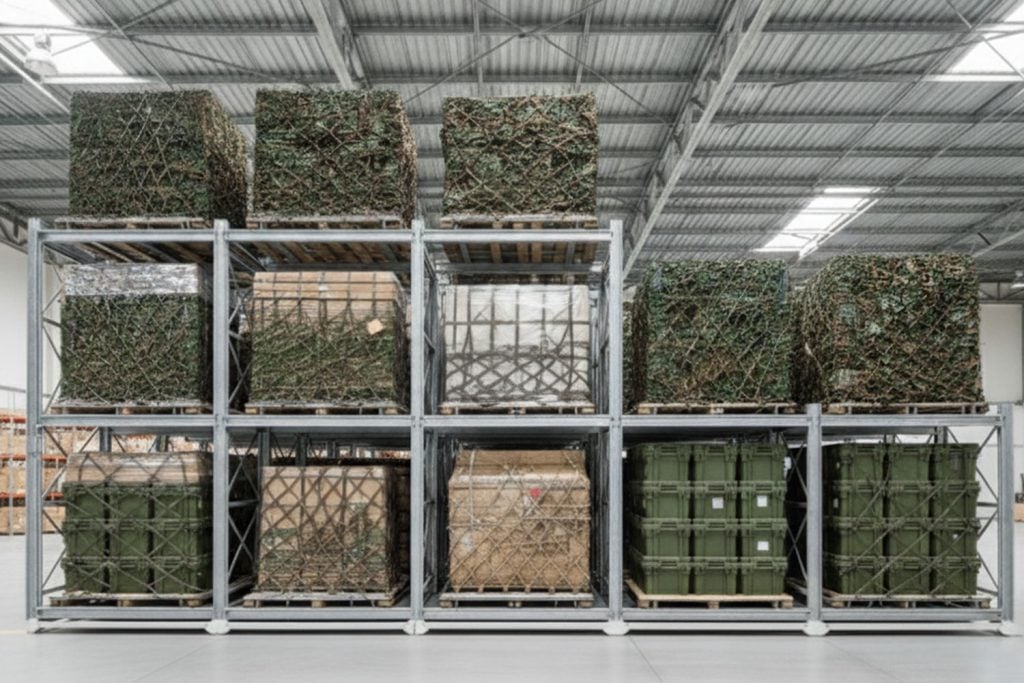
463L Pallet Rack - Military Air Cargo Rack

463L Pallet Specifications: An Enduring Logistics Standard

A standard 463L pallet measures 88″ x 108″ and is constructed of aluminum with a balsa wood core, designed to balance durability with weight efficiency. When combined with nets and tie-down systems, it allows cargo to be secured for air transport under demanding operational conditions.

The strength of the 463L system lies in its standardization. Aircraft loading systems, ground handling equipment, and staging procedures are all built around this common footprint. That consistency has supported decades of rapid deployment capability.

Because 463L pallets are so deeply embedded in military logistics, the infrastructure that supports them must be equally disciplined.

Addressing 463L Storage Challenges in Modern Defense Facilities

Many federal depots and air logistics centers were constructed long before today’s inventory volumes and operational tempo. Historically, 463L pallets were often floor stacked or stored in conventional rack systems. As operations expanded, congestion and inefficient staging became common challenges.

Agencies conducting market research on 463L pallet storage systems are frequently evaluating how to improve organization, density, and safety within existing facilities. Loaded 463L pallets can represent significant weight, and handling them requires both structural integrity and controlled access.

Improving storage is not about changing the pallet. It’s about strengthening the infrastructure around it.

Multi-Level Engineering and High-Density Staging Systems

One proven approach to 463L modernization is the use of engineered rack systems designed specifically for heavy-duty pallet loads. Multi-level storage platforms supported by structural steel can significantly increase cubic utilization while maintaining organized access.

Push systems using ball transfers or roller beds allow controlled pallet movement within defined lanes. In some facilities, vertical lifting equipment such as freight elevators or vertical reciprocating conveyors supports movement between levels, reducing congestion on the main floor.

These engineered solutions preserve the standardized nature of the 463L pallet while improving staging control and space efficiency.

Optimizing Air Cargo Workflows: Reducing Repositioning and Congestion

In many legacy environments, repositioning a 463L pallet requires extensive lift truck travel and open-floor maneuvering. Structured rack systems with integrated roller lanes reduce unnecessary movement and create defined staging zones.

Modernization in this context does not mean replacing a mission-proven platform with unnecessary complexity. It means designing storage infrastructure that reduces friction and supports rapid access when deployment requirements arise.

For agencies responsible for air cargo support, controlled staging directly influences readiness.

Structural Integrity and Government Compliance for Heavy-Duty Racking

Loaded 463L pallets demand serious structural engineering. Rack systems must be designed to handle concentrated loads, impact forces, and long service cycles. Fire suppression coordination, aisle planning, and safety compliance remain critical elements of facility design.

Agencies researching government pallet rack systems for 463L applications evaluate more than beam capacity. They assess long-term durability, inspection alignment, and integration with existing facility constraints.

In defense logistics facilities, infrastructure must perform reliably under sustained operational demand.

Integrating 463L Pallet Storage into Federal Warehouse Modernization

As federal warehouse modernization initiatives advance, 463L pallet storage is often evaluated alongside broader layout improvements. Defined transport lanes, structured staging areas, and improved material flow planning contribute to safer and more efficient handling.

While some modernization efforts across federal logistics include automation in other areas of the facility, 463L operations typically prioritize durability and structured movement over full automation. The focus remains on strengthening infrastructure to support the standardized pallet system that has served military operations for decades.

Maximizing Air Mobility Readiness Through Engineered Design

The 463L pallet remains indispensable to United States military air cargo operations. As federal facilities evaluate warehouse modernization strategies, the systems that support these pallets must deliver density, durability, and organized access without compromising safety or readiness.

Agencies conducting market research on 463L pallets, military pallet storage systems, or air cargo warehouse infrastructure are ultimately seeking engineered solutions that align with decades of standardized logistics practice.

How AW Systems Supports 463L Infrastructure

American Warehouse Systems supports federal agencies with engineered 463L pallet storage systems designed for structural integrity, compliance alignment, and long-term serviceability.

Our approach emphasizes disciplined staging design, heavy-duty rack engineering, and integration with facility constraints. Whether implementing single-level high-capacity rack or multi-tier systems supported by vertical lift equipment, AW Systems focuses on practical infrastructure that enhances operational control.

Ready to modernize your air cargo infrastructure? Contact our federal project experts today to discuss an engineered, turnkey 463L pallet storage system tailored for your facility’s evolving needs.


AW Systems: One Project. One Vendor. 

GSA procurement experts since 1990. Optimized government facility efficiency.

The Industry Standard for Federal Integration

For over 36 years, American Warehouse Systems has served as the premier GSA Prime Contractor for complex federal material handling and storage aid systems worldwide. Our expertise goes beyond providing equipment; we understand the intricacies of Federal Acquisition Regulations (FAR), Buy American requirements, and the specific security needs of mission-critical facilities. 
Inside Federal Logistics Modernization: Why Automation Is Becoming Central to Cost Control

Reshaping Federal Warehouse Modernization Through Automation

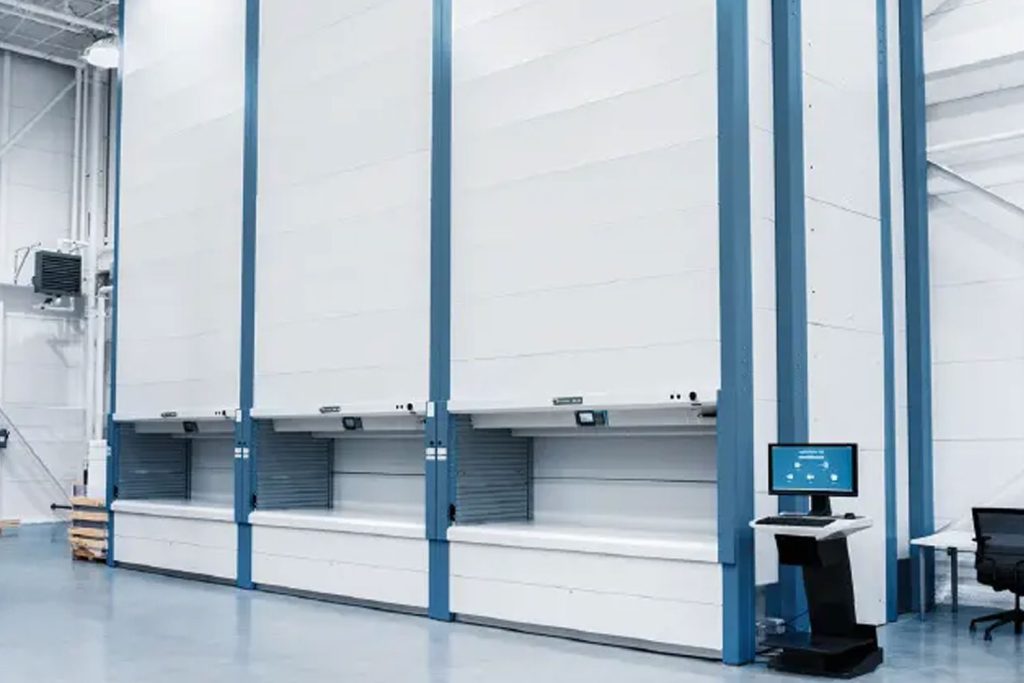
Federal logistics organizations are entering a new phase of warehouse modernization. While structural durability and compliance remain foundational, agencies responsible for national defense sustainment are increasingly evaluating automation as a long-term strategy for operational stability and cost control.

For organizations such as the Defense Logistics Agency and other federal logistics networks, modernization discussions are no longer limited to storage density or facility upgrades. The focus has shifted toward improving throughput consistency while reducing long-term exposure to labor variability. That shift is reshaping how government warehouse automation projects are planned and evaluated.

Automated Storage and Retrieval Systems for Federal Government Agencies

Operational Cost Stability Is Driving Change

Many federal warehouse operations are supported through large, multi-year service contracts. As those agreements evolve, agencies are analyzing how facility design and system infrastructure influence ongoing operating costs.

Automated Storage Systems, including miniload systems, automated parts storage, shuttle-based pallet storage, and robotic storage and retrieval technologies, is increasingly viewed as infrastructure that can stabilize performance over time. By reducing manual travel, minimizing repetitive handling, and integrating conveyor systems for controlled flow, agencies can create more predictable operational models.

When federal buyers conduct market research on warehouse modernization or logistics automation, cost stability has become part of the conversation.

Throughput Consistency Over Workforce Expansion

In defense logistics environments, the objective is sustained performance rather than short-term growth. Technologies such as unit load automation, high-density storage platforms, and integrated conveyor networks are evaluated for their ability to maintain steady output regardless of workforce fluctuations.

Federal logistics organizations prioritize systems that reduce congestion, streamline movement between zones, and support consistent order fulfillment without continual headcount expansion. Automation is attractive not because it is complex, but because it creates structural reliability.

Modernization efforts increasingly emphasize infrastructure that supports predictable flow and measurable efficiency gains.

Integration Within Existing Federal Facilities

Government warehouse modernization rarely occurs in new buildings. Many federal depots and distribution centers were constructed decades ago. Installing robotic storage systems, automated retrieval equipment, or deep-lane storage technologies requires careful integration with floor loading, fire suppression coordination, electrical capacity, and security controls.

Agencies evaluating federal logistics automation are not simply comparing equipment capabilities. They are assessing whether modernization strategies can integrate cleanly into existing facilities without disrupting compliance or operational continuity.

Technology must align with infrastructure realities.

Density, Space Optimization, and Asset Planning

Automation also addresses long-standing space constraints across federal facilities. Miniload systems and automated parts storage allow agencies to increase cubic utilization within established footprints. High-density pallet systems and robotic retrieval platforms reduce aisle requirements and manual travel distances.

Rather than expanding real estate portfolios, modernization strategies frequently focus on extracting greater performance from current facilities. Vertical expansion, controlled retrieval, and conveyor-driven material flow support both density and operational efficiency.

For agencies researching federal depot storage modernization, automation and space optimization are increasingly linked.

Robotics in Targeted Federal Applications

Robotics is gaining attention within federal logistics environments, particularly in applications that reduce repetitive manual handling and improve safety. Robotic pallet movement, automated case retrieval, and assistive storage technologies are evaluated for their ability to reduce strain on personnel while improving consistency.

In federal facilities, robotics is implemented where it supports measurable operational outcomes. The objective is not widespread experimentation, but practical deployment that enhances readiness.

Compliance Remains Embedded in Modernization

Even as automation becomes more central, federal procurement requirements remain constant. Buy American provisions, GSA contracting pathways, documentation standards, and inspection protocols shape modernization from the outset.

Agencies researching government warehouse automation systems are evaluating more than technical performance. They are assessing procurement alignment, lifecycle support, and the ability to execute within established federal frameworks.

Efficiency gains that complicate compliance do not meet federal objectives.

How AW Systems Approaches Federal Automation

American Warehouse Systems supports federal warehouse modernization by aligning automation strategy with infrastructure discipline and long-term operational goals.

When evaluating robotic storage and retrieval systems, automated parts solutions, integrated conveyor platforms, or high-density pallet storage within government facilities, AW-Systems focuses on integration clarity, serviceability, and realistic cost-control outcomes.

Automation is not presented as a standalone upgrade. It is approached as infrastructure that strengthens reliability, reduces long-term operational exposure, and integrates seamlessly into federal logistics environments.

Modernization as Long-Term Infrastructure Strategy

Federal logistics modernization is increasingly centered on controlled, purposeful automation. Agencies responsible for national defense sustainment are evaluating how warehouse infrastructure decisions today influence operational cost structures for years to come.

For those conducting market research on DLA warehouse modernization, federal logistics automation, or government storage and retrieval systems, the objective is straightforward. Modernization must enhance reliability, improve efficiency, and integrate cleanly into established federal facilities.

American Warehouse Systems approaches every modernization discussion with that long-term perspective.

Contact our federal project experts today to discuss a seamless, turnkey solution for your facility.


One Project. One Vendor. 

GSA procurement experts since 1990. Optimized government facility efficiency.

The Industry Standard for Federal Integration

For over 36 years, American Warehouse Systems has served as the premier GSA Prime Contractor for complex federal material handling and storage aid systems worldwide. Our expertise goes beyond providing equipment; we understand the intricacies of Federal Acquisition Regulations (FAR), Buy American requirements, and the specific security needs of mission-critical facilities. 
Federal Buyers Guide to Market Research: Navigating GSA Warehouse Systems & Automation

How Federal Buyers Conduct Market Research for Warehouse Systems and Automation

Long before a solicitation is released, federal buyers are already researching. Contracting officers, facility managers, engineers, and logistics personnel routinely turn to Google to understand options, terminology, and risk as they plan warehouse modernization efforts. Searches for federal warehouse storage solutions, GSA material handling systems, and government warehouse automation often begin months, and sometimes years, before a formal procurement takes shape.

This early market research phase plays a critical role in how scopes are defined, how budgets are framed, and which vendors ultimately make it onto an agency’s short list. Understanding how to evaluate systems and suppliers during this phase can significantly reduce risk later in the procurement process.

Automated Storage and Retrieval Systems on GSA Contract

Market Research Comes Before the RFP

Federal procurement is intentionally structured to ensure fairness, transparency, and compliance. That structure also means agencies must complete much of their due diligence before any vendor engagement becomes formal. Online market research allows agencies to build foundational knowledge, understand available technologies, and identify delivery models that align with federal requirements.

For warehouse projects, this research often begins with system-level questions. Buyers look for information on mezzanine systems, secure storage solutions, automated storage equipment, and GSA-approved warehouse systems. At this stage, agencies are not selecting vendors. They are developing an informed understanding of what is possible and what risks may exist.

Evaluating More Than the Equipment

One of the most common mistakes in federal warehouse market research is focusing too narrowly on individual products. A mezzanine, vertical lift module, storage rack, or locker system rarely exists in isolation within a government facility. Each system must integrate with building structure, electrical power, lighting, fire suppression, and security requirements.

Federal buyers who limit their research to equipment specifications often discover too late that the real challenge lies in integration. Equipment that appears ideal on paper can introduce complications if the vendor lacks experience coordinating ancillary trades or navigating federal compliance requirements.

As a result, experienced buyers increasingly evaluate not only what a vendor sells, but how that vendor delivers.

The Importance of Federal Experience

Federal facilities operate differently than commercial warehouses. Procurement pathways, inspection processes, and compliance obligations influence every stage of a project. Buyers conducting market research should look for vendors with demonstrated experience supporting federal material handling systems and government warehouse environments.

This experience matters because it shapes how projects are planned. Vendors familiar with GSA procurement, Buy American requirements, and federal inspection processes tend to anticipate challenges rather than react to them. That foresight reduces schedule risk and minimizes costly changes during execution.

Identifying Integration Risk Early

Market research is the best time to identify integration risk. When responsibility for a warehouse project is divided across multiple vendors, agencies often become the de facto integrator. This creates coordination challenges that extend timelines and complicate accountability.

Federal buyers researching turnkey warehouse solutions often do so after experiencing these challenges firsthand. Early research that considers delivery models, integration capability, and scope ownership helps agencies avoid fragmented projects and unclear responsibility.

This is not about selecting a vendor prematurely. It is about understanding which approaches align with the realities of federal facilities.

Understanding GSA Schedules and Procurement Alignment

Many federal buyers conducting market research focus specifically on GSA warehouse storage solutions. GSA schedules can streamline procurement, but they do not eliminate the need for careful evaluation. A system being available on GSA does not automatically ensure that it can be delivered as a complete, functional solution.

Effective market research considers how systems are procured, how scopes are structured, and how supporting work is coordinated under a single contract. This understanding allows contracting officers and program managers to develop procurements that support timely, compliant execution.

Applying Research to Real Federal Facilities

In government warehouses, depots, and logistics centers, success is measured by readiness and reliability. Systems must be serviceable, compliant, and integrated into existing operations without disruption. Market research that reflects these priorities leads to stronger outcomes.

Federal buyers who approach research thoughtfully tend to ask broader questions. How will this system be installed? Who coordinates supporting trades? How is compliance managed? What happens if conditions change during execution? These considerations shape better procurements long before a contract is awarded.

How AW-Systems Supports Informed Federal Decisions

American Warehouse Systems supports federal agencies by providing clear, practical information during the market research phase. Our role is not to push a single product, but to help agencies understand how storage and material handling systems function within real federal environments.

By focusing on complete solutions, integration, and procurement alignment, AW-Systems helps federal buyers move from research to execution with confidence. This approach reflects decades of experience supporting government warehouse projects across a wide range of applications.

Market Research Is Risk Management

Prime integration is not a premium feature. In federal environments, it is a safeguard. Integration ensures that systems are delivered ready for use, inspections proceed smoothly, and facilities can support their operational missions without unnecessary delay.

Federal warehouse projects succeed when responsibility is clear, scope is aligned, and accountability rests with a partner structured to manage it.

Bridge the gap between market research and execution

Don’t let integration gaps derail your warehouse modernization. Partner with AW Systems during your planning phase to ensure your GSA-procured systems are fully coordinated, compliant, and mission-ready.

Contact our federal project experts today to discuss a seamless, turnkey solution for your facility.


One Project. One Vendor. 

GSA procurement experts since the 1990s. Optimized government facility efficiency.

The Industry Standard for Federal Integration

For over 36 years, American Warehouse Systems has served as the premier GSA Prime Contractor for complex federal material handling and storage aid systems worldwide. Our expertise goes beyond providing equipment; we understand the intricacies of Federal Acquisition Regulations (FAR), Buy American requirements, and the specific security needs of mission-critical facilities. 
Why Federal Warehouse Projects Fail Without a Prime Integrator: Reducing Risk in GSA Material Handling

In the federal environment, a procurement is only successful if the equipment is operational, compliant, and integrated into the facility’s mission. However, a significant accountability gap often exists between the point of purchase and the final inspection.

While a standard vendor is responsible only for delivering a product, a prime integrator assumes responsibility for the entire project. This includes ensuring that complex storage systems interface seamlessly with building codes, fire suppression, and electrical infrastructure.

Without this single point of contact, federal agencies often find themselves unintentionally acting as their own general contractors. They are left managing scope gaps and trade conflicts that lead to cost overruns and mission delays. Understanding this distinction is the first step towards executing successful projects.

GSA Project Manager

Why Federal Facilities Need a Prime Integrator, Not Just a Vendor

Federal agencies routinely conduct online market research before initiating any formal procurement. Contracting officers, facility managers, and engineers search for information on federal warehouse storage solutions, GSA material handling systems, and turnkey infrastructure providers long before a solicitation is released. What they often find is a fragmented marketplace, vendors focused on individual products rather than complete outcomes.

Federal facilities are complex by design. Government warehouses, maintenance depots, and logistics centers support mission-critical operations and operate under layers of regulation that do not exist in commercial environments. Yet when it comes time to modernize storage systems, install mezzanines, or integrate material handling equipment, projects are still frequently treated as isolated equipment purchases.

They are not.


The reality of federal warehouse projects

A typical federal material handling project involves far more than the system itself. Mezzanine platforms, storage racking, TA-50 gear lockers, secure wire partitions, or automated storage systems must all interface with existing buildings, utilities, and safety systems. Concrete foundations, floor loading, electrical power, lighting, fire suppression coordination, and secure access controls are not optional. They are required for the system to function inside a government facility.

Many vendors sell only the system. Once their equipment is delivered, responsibility for everything else shifts back to the agency. That leaves federal buyers managing multiple contractors, coordinating schedules, resolving scope gaps, and absorbing the risk when something goes wrong.

This is where federal projects begin to struggle.


Fragmentation Creates Risk, Not Efficiency

When responsibility is divided across multiple vendors and trades, accountability becomes unclear. One contractor waits on another. Inspections uncover conflicts that should have been addressed during design. Change orders become common, and schedules stretch beyond what was originally planned.

In commercial facilities, these issues create frustration and cost overruns. In federal environments, the impact is more significant. Delays affect readiness. Storage systems sit idle while agencies navigate additional procurement actions. Equipment intended to improve efficiency remains unused because ancillary work was never fully coordinated.

This is not a failure of effort or intent. It is the predictable outcome of fragmented responsibility.


Why Federal Projects Require a Different Approach

Federal procurement is fundamentally different from commercial purchasing. Government buyers must comply with FAR requirements, Buy American provisions, and agency-specific contracting rules. Many projects are procured through GSA schedules, where scope clarity and compliance matter as much as price. Security considerations often involve controlled areas, sensitive materials, or enhanced physical protection. Overseas installations add further complexity, including host-nation coordination and logistical constraints.

In this environment, managing a federal warehouse project through disconnected vendors increases risk rather than reducing it. What agencies need is a prime integrator, not simply a system supplier.


What does a GSA Prime Integrator Provide

A prime integrator assumes responsibility for the complete project, not just the equipment. This includes system selection, layout development, integration with building infrastructure, and coordination of all supporting trades. The integrator owns the sequencing, the interfaces, and the outcome.

For federal buyers conducting market research on turnkey material handling systems or GSA warehouse solutions, this distinction matters. A prime integrator provides a single point of accountability. The agency has one contract, one point of contact, and one entity responsible for delivering a functional, compliant solution.

This approach is not about convenience. It is about managing risk in federal facilities.


The Cost of “No Single Point” Accountability

When no party owns the full scope, agencies are forced into a coordination role they were never intended to fill. Contracting officers manage interfaces between vendors. Facility managers chase schedules across multiple contractors. Inspectors identify conflicts late in the process, after changes become expensive and time-consuming.

The result is familiar across government warehouse projects. Timelines extend. Budgets tighten. Operational improvements are delayed. None of this improves mission readiness.

A system that remains incomplete due to coordination gaps provides no value, regardless of how advanced the equipment may be.


How AW-Systems Approaches Federal Integration

American Warehouse Systems has supported federal and government warehouse projects since the 1990s with a different philosophy. AW-Systems operates as a prime integrator for federal material handling and storage systems, assuming responsibility for both the core system and the ancillary work required to make it operational.

This includes coordination of concrete, structural considerations, electrical power, lighting, fire suppression interfaces, and secure enclosures as part of a unified scope. From early planning through installation, AW-Systems remains accountable for how the system functions within the facility, not just how it is delivered.

By managing the entire scope, AW-Systems eliminates the gaps that commonly delay federal projects and replaces them with continuity and clarity.


Procurement Confidence for Federal Buyers

Execution alone is not enough in federal procurement. Agencies need confidence that purchasing aligns with established contracting frameworks. Many government buyers conducting market research look specifically for GSA approved warehouse systems and vendors experienced with federal procurement processes.

AW-Systems supports federal agencies through active GSA schedule contracts, registration in the System for Award Management, and compliance with Buy American requirements where applicable. This structure allows contracting officers and project managers to move forward without layering multiple procurements for what is, in reality, a single integrated project.


Integration Is Risk Management

Prime integration is not a premium feature. In federal environments, it is a safeguard. Integration ensures that systems are delivered ready for use, inspections proceed smoothly, and facilities can support their operational missions without unnecessary delay.

Federal warehouse projects succeed when responsibility is clear, scope is aligned, and accountability rests with a partner structured to manage it.


A Better Way Forward for Federal Facilities

Federal facilities do not fail because of poor equipment selection. They fail when responsibility is divided and ownership is unclear. By engaging a prime integrator, agencies shift coordination and risk away from internal teams and place it with a partner equipped to manage complex, compliant projects.

American Warehouse Systems was founded on this principle – one project, one point of accountability, one partner responsible for delivering complete, compliant material handling systems for government facilities. For federal buyers researching turnkey warehouse solutions, prime integration is not optional. It’s how projects get completed and missions stay supported.

Ready to modernize your facility with a complete, turnkey solution?  Contact an AW-Systems prime integration expert, your GSA-approved partner for fully coordinated storage and material handling systems designed specifically for federal environments.


One Project. One Vendor. 

GSA procurement experts since the 1990s. Optimized government facility efficiency.

The Industry Standard for Federal Integration

For over 36 years, American Warehouse Systems has served as the premier GSA Prime Contractor for complex federal material handling and storage aid systems worldwide. Our expertise goes beyond providing equipment; we understand the intricacies of Federal Acquisition Regulations (FAR), Buy American requirements, and the specific security needs of mission-critical facilities. 
Vertical Lift Modules vs. Vertical Carousels: Automation for Federal Storage

Automated Storage With Federal Reality in Mind

Federal agencies are continually asked to improve efficiency, maximize available space, and maintain accountability, all while operating within strict procurement and compliance frameworks. While automation has become common in commercial distribution centers, government facilities tend to adopt new technology more deliberately. Reliability, serviceability, and long-term support often matter more than peak throughput metrics.

Two automated storage technologies have proven themselves over time in federal environments: Vertical Lift Modules and Vertical Carousels. Both provide meaningful advantages when applied correctly, and both continue to support mission-critical operations across government facilities. The challenge for agencies is not whether to automate, but how to select the right technology for their specific operational requirements.

At American Warehouse Systems (AW Systems), our role is to help agencies understand where each system fits best and how to deploy it in a way that supports the mission today while remaining adaptable for the future.

Automated Storage and Retrieval Vertical Lift Systems


How Vertical Storage Solves Federal Facility Challenges

Across federal warehouses, maintenance shops, and supply rooms, the same challenges appear repeatedly. Floor space is often limited, even when significant vertical height is available. Inventories tend to include a wide mix of parts, tools, and consumables, many of which are controlled or subject to audit. Staffing constraints and ergonomic concerns are common, and many facilities lack the scale or justification for large, high-complexity automated storage and retrieval systems.

Vertical storage addresses these challenges by consolidating inventory upward and delivering items directly to the operator. This approach improves space utilization, reduces travel time, and supports stronger inventory control without introducing unnecessary operational complexity or risk.


Vertical Lift Modules: Flexible Storage for Changing Inventories

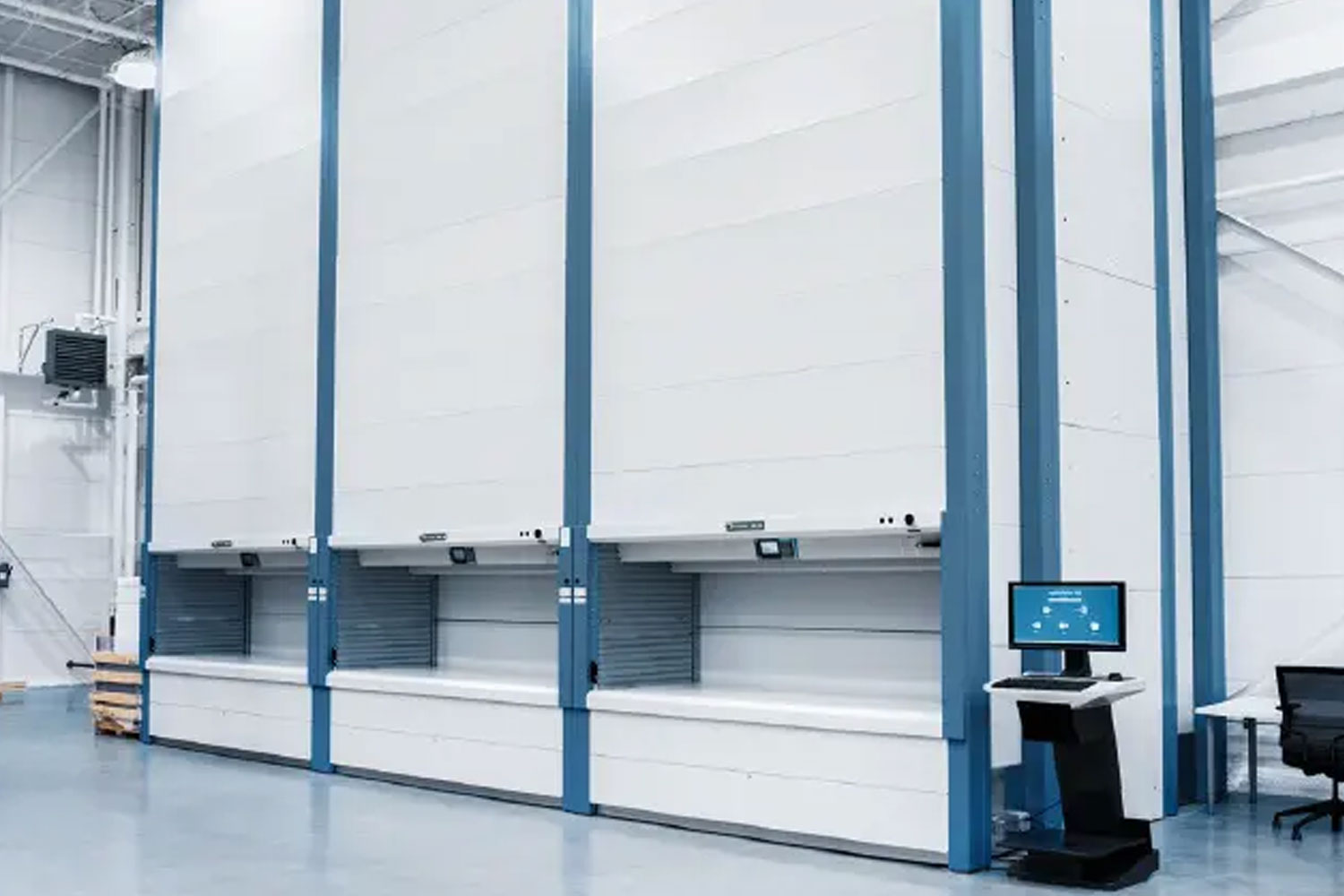
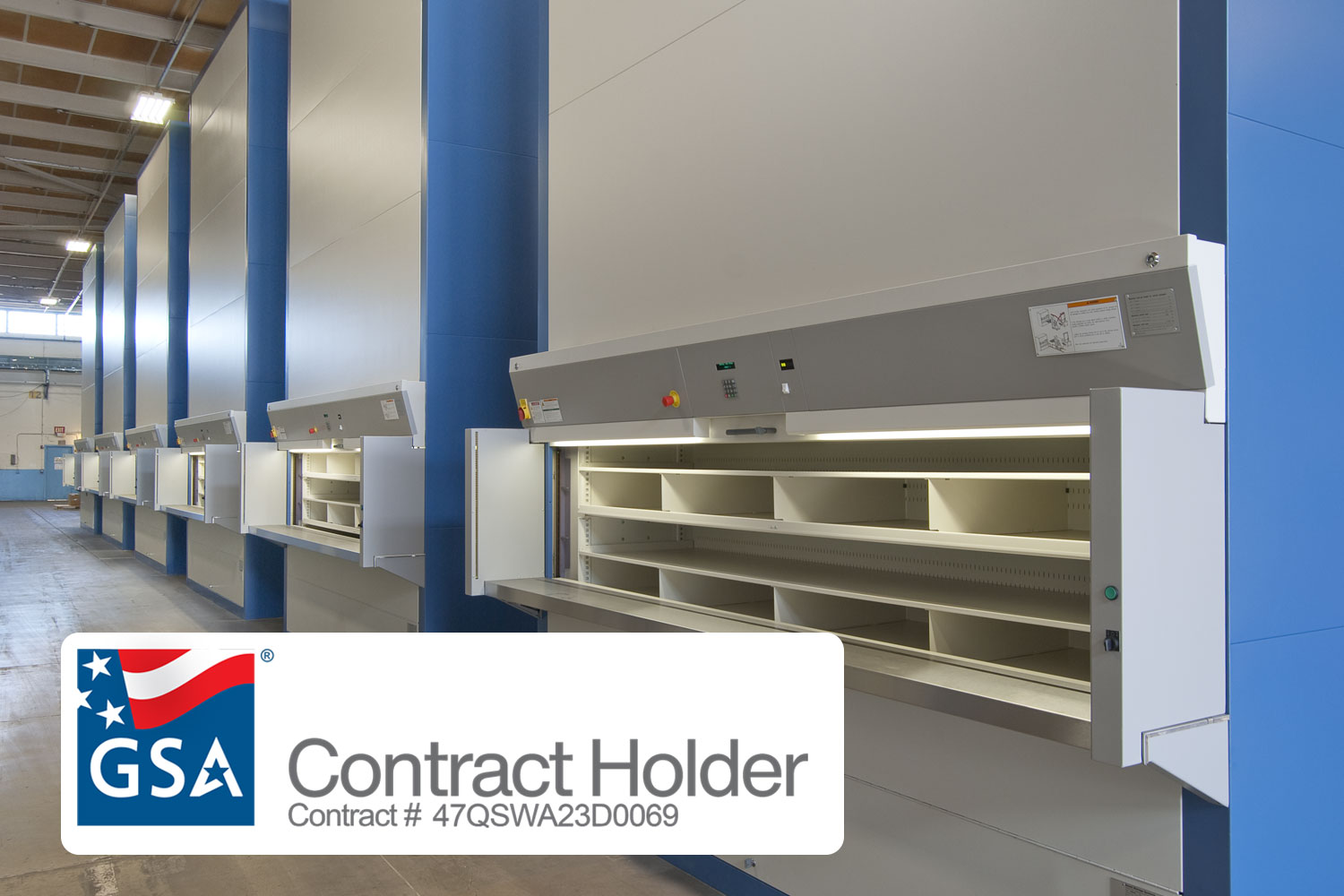
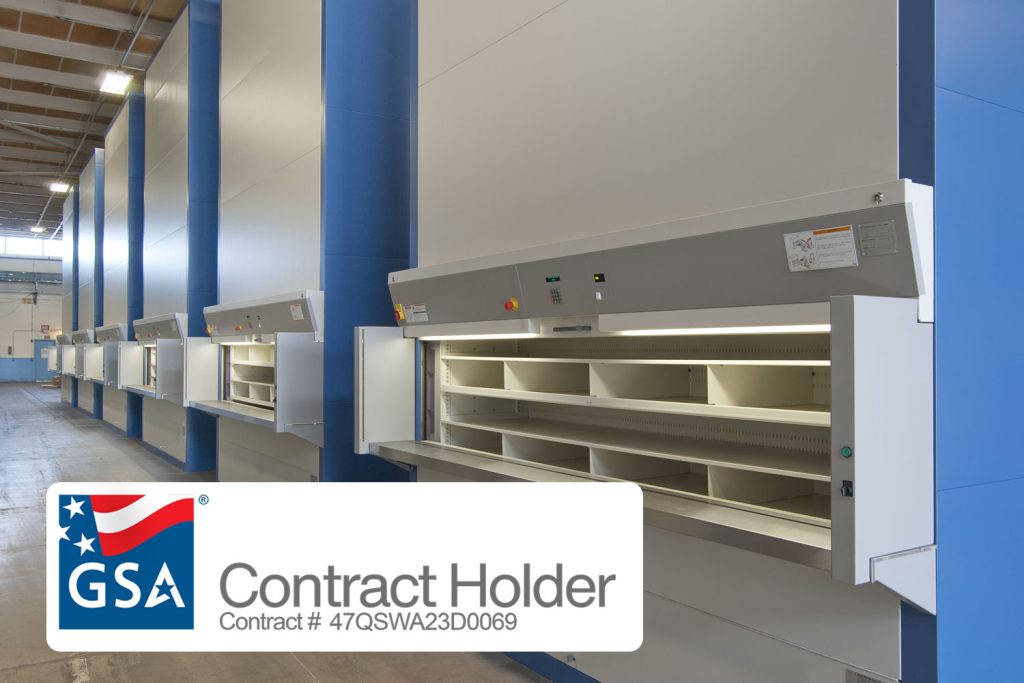
A Vertical Lift Module uses two columns of trays and an internal extractor to retrieve trays and present them at an ergonomic access opening. Tray heights are dynamically adjusted, allowing the system to accommodate a wide range of item sizes efficiently.

VLMs are often selected in environments where inventory profiles vary or change over time. Their ability to adapt to different item dimensions allows agencies to maximize storage density while maintaining flexibility as mission requirements evolve. Because these systems are fully enclosed, they also support controlled access and accountability, which is particularly important in federal environments.

In practice, VLMs are commonly deployed in parts rooms, tool cribs, and maintenance operations where mixed inventory, security, and long-term adaptability are key considerations. Their design allows agencies to improve organization and access without locking themselves into a fixed storage configuration.


Vertical Carousels: Proven, Familiar, and Dependable

Vertical Carousels operate using a rotating series of carriers that bring items to a fixed access point. This technology has been used successfully for decades and remains well understood across both commercial and government operations.

Carousels tend to perform well in applications where inventory is consistent and predictable. Their straightforward mechanical design, predictable operation, and long service life make them familiar to many operators and facility managers. In environments where agencies value standardization and ease of training, vertical carousels continue to provide dependable performance.

Many federal facilities still rely on vertical carousels as long-term storage solutions, particularly for uniform parts, kits, or files. When matched appropriately to the application, they remain a reliable and effective form of vertical automation.


Evaluating the Right Fit for Federal Operations

Rather than viewing Vertical Lift Modules and Vertical Carousels as competing technologies, federal buyers benefit most when each system is evaluated based on the specific operational context. Facilities with highly variable inventory and evolving requirements often value the flexibility and enclosure provided by VLMs. Facilities with stable, uniform storage needs may prioritize the familiarity and simplicity of vertical carousels.

In both cases, the success of the system depends less on the technology itself and more on how well it is matched to the mission, the facility constraints, and the agency’s long-term operational goals.


Common Federal Applications

At AW Systems, vertical storage systems are commonly deployed in Defense Logistics Agency maintenance and repair depots, National Guard readiness centers, base supply rooms, embassy maintenance areas, and federal research facilities. Each of these environments presents different challenges, from space constraints to accountability requirements.

In one recent federal maintenance application, AW Systems implemented a Vertical Lift Module to consolidate multiple shelving aisles into a single secure footprint. The result was improved space utilization, better organization, and enhanced inventory control. In other facilities, vertical carousels continue to operate reliably as established storage systems supporting uniform inventory.


Right-Sized Automation

One of the most important considerations in federal automation is avoiding overreach. Systems that introduce unnecessary complexity can create training challenges, extend approval timelines, and increase long-term lifecycle risk.

Both VLMs and vertical carousels offer a measured approach to automation. They provide automated retrieval without overwhelming operations, rely on proven technology, and remain manageable from a maintenance and support perspective. When applied thoughtfully, either system can deliver meaningful efficiency gains while aligning with federal operational realities.


The AW Systems Turnkey Approach

Successful automation does not exist in isolation. Floor loading, power requirements, fire suppression integration, lighting, and access control all influence system performance and compliance. These elements must be coordinated carefully to ensure the final installation functions as intended.

AW Systems delivers vertical storage solutions as part of a complete, integrated scope. From system evaluation and layout development to coordination with electrical and fire protection requirements, our team provides a single point of accountability from design through installation. This approach simplifies procurement, reduces risk, and ensures that systems are delivered and supported correctly.

One Project. One Vendor. This model allows agencies to focus on mission readiness rather than vendor coordination.


Procurement Confidence Built-In

Federal buyers work with American Warehouse Systems knowing procurement requirements are addressed from the outset. AW Systems holds an active GSA Schedule Contract (47QSWA23D0069), is registered in the System for Award Management, and is accredited through the Small Business Administration. Our experience supporting DLA and federal facilities worldwide allows agencies to move forward efficiently while maintaining full compliance.


Automation Technology Aligned to the Mission

Both Vertical Lift Modules and Vertical Carousels have earned their place in federal facilities. The key is selecting the right technology for the specific mission, inventory profile, and operational environment.

AW Systems works with agencies to evaluate options objectively and implement vertical storage solutions that are reliable, supportable, and aligned with long-term needs.

One Project. One Vendor. It is how we help federal facilities make smart, sustainable automation decisions.

Ready to evaluate vertical storage options for your facility?

Contact an AW Systems storage automation expert, your GSA-approved partner for automated storage solutions designed for federal environments.